Xorg X11 Server Crashing After Update

24. September, 2012


After installing a new version of xorg-x11-server, it started crashing every time I started chromium. The effect was consistent: Every time I started the browser, the screen would go black and I’d be back in the login screen.

Looking into /var/log/kdm.log, I saw these lines:

Backtrace:
0: /usr/bin/Xorg (xorg_backtrace+0x36) [0x564616]
1: /usr/bin/Xorg (0x400000+0x168349) [0x568349]
2: /lib64/libpthread.so.0 (0x7f1d1618b000+0xf140) [0x7f1d1619a140]Segmentation fault at address (nil)

The reason for the error was that the xorg-x11-server contains the file /usr/lib64/xorg/modules/extensions/libglx.so which is needed for the NVIDIA driver but the NVIDIA driver has its own, special version.

The fix for the error was to reinstall the NVIDIA driver again.

Related posts:


Could not find a GenModel for EPackage ‘http://www.eclipse.org/xtext/common/JavaVMTypes’

20. September, 2012

If you added

import "http://www.eclipse.org/xtext/common/JavaVMTypes" as jvmTypes

to your DSL and now you get this error:

java.lang.RuntimeException: Could not find a GenModel for EPackage 'http://www.eclipse.org/xtext/common/JavaVMTypes'
If the missing GenModel has been generated via EcoreGeneratorFragment make sure to run it first in the workflow.
If you have a *.genmodel-file, make sure to register it via StandaloneSetup.registerGenModelFile(String)
	at org.eclipse.xtext.generator.GenModelAccess.getGenModelResource(GenModelAccess.java:119)
	at org.eclipse.xtext.generator.ecore.EcoreGeneratorFragment.findEPackagesInGenPackages(EcoreGeneratorFragment.java:347)

then add this line

registerGenModelFile = "platform:/resource/org.eclipse.xtext.common.types/model/JavaVMTypes.genmodel"

to the “bean” block in your MWE2 workflow. It should then look like this:

Workflow {
    bean = StandaloneSetup {
        scanClassPath = true
        platformUri = "${runtimeProject}/.."
		registerGenModelFile = "platform:/resource/org.eclipse.xtext.common.types/model/JavaVMTypes.genmodel"
    }

How To Ask Questions The Smart Way

20. September, 2012

When you write software, you get bug reports and pleas for help. When you use software, you sometimes (or even often) stumble over problems and need help.

Since processes of this type involve more than a single person, friction occurs. To reduce this friction, read this document: “How To Ask Questions The Smart Way

It’s a good read for both sides. It will help you understand why some questions irritate you and it will help you understand why you didn’t receive any help when you had a problem.


Firefox Crashing When Opening a New Window in openSUSE 12.2

11. September, 2012

Does Firefox crash for you when you open a new window?

Report the crash using the built in tool, then browse “about:crashes” (shows you which crashes you reports), click the topmost link.

If frame #0 in “Crashing Thread” (bottom of the page) reads “libtracker-sparql-0.12.so.0.1205.0”, then this package is the culprit: tracker-miner-firefox

Delete it and Firefox should work again. If that helps in your case, you’ve been hit by this bug.

What’s this piece of crap do? From the web site:

Tracker is a semantic data storage for desktop and mobile devices. Tracker uses W3C standards for RDFontologies using Nepomuk withSPARQL to query and update the data.

If you don’t know, Nepomuk is the great technology that builds search indexes over anything on your disk. Unfortunately, it’s developed by people who believe quality in software is nice to have. So it tends to hog the CPU wasting your time, it can fill your harddisk with useless junk, and please, don’t run it on computers with more than 100 MB (that’s 0.1 GB) of disk space or more than 1’000 files; otherwise, it might never finish. If you try to search something, bring some time – useless results take a moment to come up with.

Don’t disable it either, or apps like Dolphin will be unhappy. It’s already beyond the abilities of these people to hide the UI elements for rating and tags when you try to protect yourself.

I opened a bug to have Nepomuk removed from KDE until it reaches alpha status but that bug was closed.

‘Nuf said.


BundesGit: Tracking Law Changes With Git

10. August, 2012


Git is one of those tools with a thousand uses. Now, it’ s 1001. Stefan Wehrmeyer has started to put texts of German laws into Git to make it easier to track changes.

Related articles:


Terminal plug-in for Eclipse

6. August, 2012

If you’re like me, then you’re spending a lot of time using console windows because some tasks are just so much more efficient (recalling old commands, pipes, …). If you use Eclipse, you will always struggle to squeeze the terminal window on the screen somewhere.

To help with this situation, Google has developed a plug-in to embed a command-line terminal into your workspace: ELT

It currently supports Linux (x86 32 and 64 bit) and Mac OS X (PPC, x86 32 and 64 bit) only. ANSI escape sequences (incl. color codes) are supported as well a hyperlinks.


Excellent Explanation of PermGen Issues

27. July, 2012

If you develop web apps, you have encountered java.lang.OutOfMemoryError: PermGen.

Nikita Salnikov-tarnovski wrote an excellent article where these come from and how to solve them: Busting PermGen Myths


Software Development Costs: Bugfixing

21. July, 2012

(Second part of three; first part is here)

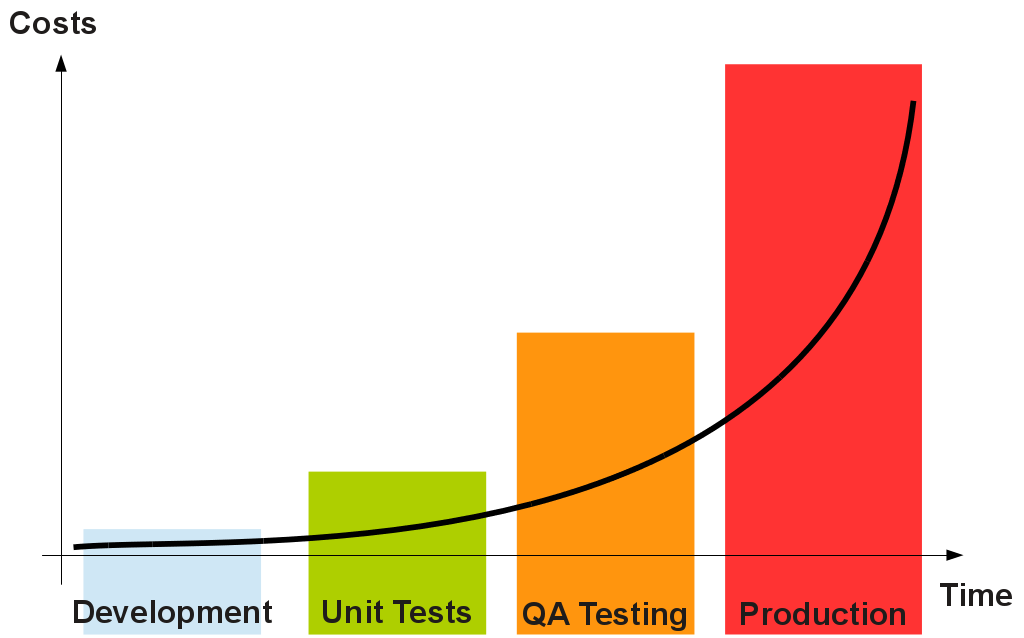
Software has bugsthere simply is no way to avoid them. If you can’t avoid them, maybe you can handle them efficiently? Yes, you can:

As you can see, the cost of fixing bugs rises as time passes. Why is that?

There are many reasons:

  • When you find a bug a couple of minutes after you created it, you probably still have all the information in your head that is necessary to understand and fix it.
  • If you just created the bug, no code depends on it. As soon as you start writing unit tests and more code, fixing becomes more expensive because you start to have dependencies.
  • People might have gotten used to the bug and developed workarounds. If you fix the bug, this will have an impact on them.
  • A bug found in production is likely to be reported by a customer. Customers can’t see inside of your software, so extra effort will have to be spent to determine what the actual problem is. Google for “how to report bugs
  • When a bug is discovered at the customer, it might trigger meetings and scapegoat hunting. Think of it this way: A 1 hour 8 person meeting costs about $1’000. And no bug was ever fixed in a meeting.
  • Some bugs escalate to the top-level management. Imagine for a moment what it would mean for you if their CEO called your CEO to complain about a problem you caused.
  • Bugs might break expensive things, harm or even kill people or start World War 3.

This also explains why unit testing is so much more efficient to QA testing for many kinds of bugs: It simply catches them before they spread their bad influence.

So fix your bugs early, OK?

Related articles:


CBI or Taking The Pain out of Eclipse Builds

20. July, 2012

When a project is young and dashing, mistakes are made. The PDE build process is such a mistake. If you ever tried to build Eclipse (or at least some of the older parts), then you know that this is brittle and the error messages are more like mysterious ramblings of an angry deity than helpful.

Enter stage CBI. From the FAQ:

 The CBI build of the Eclipse platform is intended to produce the same output as the PDE build, and thus facilitate packaging without noticeable change. The noticeable difference the CBI build of the platform makes is ease of use to build the platform. For example, the prototype has consistently demonstrated that a newcomer without prior experience can build the Eclipse platform with under 30 minutes of effort on a machine with a supported JDK & Maven.

What can I say?

Finally!


Chrome Experiments

19. July, 2012

If you want to see what’s possible in today’s browsers, go to Chrome Experiments.

My picks: