Oracle sells OpenOffice 3.3

17. December, 2010
OpenOffice

Image via Wikipedia

Wanna buy OO? Oracle gets in line with all the rip-offs who sell you open source software and, as a special bonus, it sells you a crippled version: For home users, you get a copy that supports just one language, one OS, no SDK, no MySQL connector. Oh, there is forum based support!

In which way is that better than the download from OpenOffice.org which I get with more features and for free?

Well, there isn’t a release on the project’s official website. I guess Oracle redefined the meaning of open source software: It’s just the source, now. Use your own compiler.

LibreOffice, here I come. They also don’t have a release but at least I feel that they’re honest and show some basic respect.


Hot or not

1. September, 2010
no spam!

Image via Wikipedia

When I write a post, I’m always wondering if someone cares. Since I’m not one of the top 1’000 bloggers who rally millions of readers, I just get so many hits and it’s hard to find out what people like to read.

Today, I noticed something: Some articles get more spam than others. Since spammers want to get noticed, they are more likely to spam the hot stuff.

Problem solved 😉


Copyright vs. authors

17. August, 2010

Everyone always argues “we need a strong copyright to protect the authors and their work” (here, for example). Frankly, I’m very suspicious how many authors are in this “we”. Usually, this “we” includes publishers, lawyers and people living off the work of authors but rarely those who actually do the work.

Just two days ago, I stumbled over an article (German) that compared the book market in England and Germany around 1800. The time is interesting because Germany had no copyright before 1837 and England had one for almost a century by that time. Of course, everyone in Germany was arguing that authors were starving and they needed a stronger copyright – just like England.

Before these copyright laws were enacted, the book market in Germany was between five to ten times bigger than that of England. A book in England would cost as much as you’d make in a week – between $500 and $1000 today. As a consequence, only very few people had books. In Germany, everyone could afford books. In 1800, only 700 news books were published in rich England while in poor Germany, they had 4000. They were cheap. Since only a few people could afford the expensive English books, print runs were tiny. A “successful” book would means a print run of 500 to 750. Reprinting was outlawed, so as soon as a book went out of print, it wasn’t available anymore. And who would reprint something that sold only 700 times?

And, surprisingly, the authors could live from their work. Around 1810, the author of a monograph could make 25% to 50% of a year’s income. In England, bestsellers got more but there are only a few bestsellers. It’s nice that 5 or 10 of the most successful authors make millions but isn’t it better when most people make enough for a living?
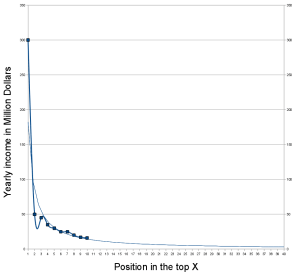
Yearly income of the most successful authors 2008

Yearly income of the most successful authors 2008

Why did that happen?

Because so many books were printed. Publishers always needed new material, so the authors were in a position of power. Also, “unsuccessful” books sold many thousand times. Publishers also had to keep them in print (as long as it was reasonable) to keep reprinters at bay. With a strong copyright, authors had to beg to be published (except for the few successful ones). Guess what that meant for income.

What happens today? Anyone can publish. Google has written software that collects interesting bits of information all over the globe and presents them in a nice, accessible way. Suddenly, the publishers cry out: “We need a stronger copyright.” I bet they do. But I don’t buy it when they add “to protect the rights of our authors.”

Which rights? The ones they take away with slave contracts? “Author gets 4% of the price printed on the book and publisher gets the right to publish the work in any way, forever.”

How many authors do you know which made a fortune from their books? Name five. King. Rowling. Patterson. Clancy (doesn’t even have a web site; poor guy only makes $35 Million/year). Steel. (Source)

I didn’t know two of them and the difference between #1 (Rowling, $300 Million) and #5 (Steel, $30 Million) is tenfold. See the graph for an idea where this leads.

Penguin sells books for £786 Million/year. This weeks bestseller in “Stolen” by Lesley Pearse. Amazon rank  118. I wonder how much of the $780m Ms. Pearse makes.

The next time someone tries to sell you that the copyright is good for authors, you know they’re lying.


Glasshouse

8. April, 2010

I just finished reading Glasshouse by Charles Stross.

The book was advertised as the next great thing and it was a nice read. Charles definitely did think a lot of things through like what you will be able to do when you can manipulate matter to the atomic level. As in “manipulate the mind.” We know drugs can change how your brain works but how about you can modify each and every molecule of your brain?

In these terms, the book is a good read. People can backup themselves and if you get killed, you can suddenly find yourself in an odd situation because you don’t knew what happened just that something must have gone wrong. As we software specialists say: Backup early and often.

Overall, I like the book and the presented ideas. Some things don’t seem to make sense but eventually, all puzzles are resolved (with the exception why Robin suddenly wakes up elsewhere; my guess is that he got killed after signing the contract but I’d have expected a message from the people running the experiment in this case which explains the situation to poor Robin).

There is just one glaring bug: The bad guys left a really powerful device in a place where the protagonist has pretty much unlimited, unsupervised access. I understand that high level surveillance wasn’t allowed by the rules of the game at this place but a simple switch which sends a signal “trapdoor is open” would have been more than enough. Of course, the story wouldn’t have worked anymore. Oh well. If you can ignore this, you’re in for some fresh SciFi ideas.

Also, Charles likes deus-ex-machina, so you’ll have several situations where the heroes are in a deadly trap and suddenly, you learn that they did plan for this situation and they get away. Acceptable once or twice but not that often.

Recommendation: Consider to buy.


Demons? Really? Really! But not as you think

23. February, 2010

I just read Linus Torvalds’ post “Demons? Really?” Which is about exorcism in case you don’t want to read his piece. Apparently, there are people who believe that you can drive a demon with prayers from a human body. Which is complete nonsense according to Linus.

Really?

What are we talking about here? What is a demon? I’m not sure what the scientific definition would be but I’m pretty sure that the people discussing the topic don’t know either. They don’t care. For them, the demon is not important but to help the possessed.

From our scientific eye, talking about demons and exorcism is ridiculous. We assume that a demon is probably some kind of sickness and the poor victim would be better off in a hospital or psychiatric care. They are just sick. Just imagine when you are in pain. It affects your mood: You become thin-skinned and easily irritated. So the sickness has a mental component.

Treating the sickness would solve the mental issues. So we’re happy and the missionaries must be stupid. Or so we think.

Question: Have you ever been in this situation? In a village thousands of miles away from anywhere? Without clear water, healthy food, and people with a yearly income in the range of $5 or less? Good luck finding medicine for them or sending them to a doctor. They either have no access to such resources or can’t afford it.

What do you do? Walk away, happy with the fact that you know what would help? Or do you stay and try to help to the best of your abilities?

If you stay, what can you do? You have no medicine, you’re no doctor and you probably have no idea what is really going on. There are people around, probably from the same village who think “I don’t know what he has but I don’t want it! Let’s get rid of him before we all get sick!” These people still have to learn that modern science exists. They couldn’t care less because for them, the biggest issue is how to get enough food to survive another week. National Geographics? FDA? These are all non-issues for these people.

For them, the sick are possessed because that is something they can relate to. It explains the unknown. Demons can be shooed away.

So what do you do? Stick to your scientific knowledge? Or do you start to pray to drive the demon out? Showing compassion, doing what is expected from you, possibly triggering the self-healing effects of a placebo? Doing what you can in such a situation?

Yes, we can mock these people because they probably believe that demons really exist. But maybe they have understood hundreds of years ago that science can only help the rich. People who have (almost) unbound access to good water, food and electricity.

Maybe for them, it’s more important to help than to be right.


Nation and the 6th part of the Hitchhiker

1. January, 2010

Just finished reading two books: “Nation” (Terry Pratchett) and “And Another Thing …” by Eoin Colfer.

When I browse through my favorite book store here in Zurich, I’m always looking for something new by Terry Pratchett. I’m a huge fan of his Diskworld series and always torn when there still isn’t another volume out. On one hand, I really miss his witty way to look at the world, on the other, a good thing takes time. So this time, I ambled into the other works of Pratchett but after the the carpet people and “Johnny and the bomb”, I wasn’t too thrilled. But I couldn’t walk away from “Just possibly the best book Pratchett has ever written” (Fantasy and Science Fiction).

And it is. It’s a hugely different setting than Diskworld but as witty and smart as you’d expect. It’s the story of a boy who sets out to become a man and becomes so much more. It’s about standing up against peril, evil and bullies. If you like Diskworld, you must read this, too.

Eoin Colfer was a similar issue: Part 6 of the THHGTTG? You’ve got to be kidding! I loved the stories around Artemis Fowl but The Hitchhiker? Is Eoin out of his mind? Luckily, he asked himself the same questions.

The net result: Definitely not a book by Douglas Adams but also definitely a book from the Hitchhiker series. Ever wondered where the animals come from that want to be eaten and can argue in their favor? There must be herds, right? There are. When Thor (the Norse god) needs some aiming practice, they “provide moo-ving targets”. Just like Adams, Eoin (pronounced Owen) likes to take things to the tip and I mean the utmost protruding electron. It’s a book about a world where all your wishes were granted. And you know the old saying. A fun read and at least one good laugh on every page. To put it another way: The worst thing about the book is its title.

If you’re still worrying whether you should dare to complete the trilogy with part 6, stop and buy.

Recommendation: Buy. Both. Now.


Akaelae

28. November, 2009

Don’t ask me how to pronounce that, I have no idea. Akaelae is a web-comic by Tiffany Ross. It’s one of those rare gems that warm the heart (and not only by raising your adrenaline level). If you like Stan Sakai’s Usagi Yojimbo or Elfquest, you’ll live this, too. It’s the story of a couple of childhood friends that get in all kinds of adventures at school, home, even space. The focus is rarely on the action but on the emotions and reasons of the characters. It’s about how people can hurt each other and how they deal with it. Here is an example: Darrik, a young, lonely black fox is moving to a new room and wants to say goodbye to a shy albino fox that’s living on the same floor. During the chat, she tells him that the wolves are only keeping them to sell them as slaves later. Which is why she is refusing to take the proficiency tests.

Darrik is confused. “Then aren’t you useless to them? If they’re running a slave trade? Wouldn’t they just sell you instead of feeding you, giving you clothing, art supplies, medical attention?”

Conclusion: Buy. You can find the whole story in the archive or support the starving artists by buying her books as PDF downloads over Lulu.

If you get confused with the characters and the names, visit the ComixPedia page: “The Cyantian Chronicles“.

Note that the Cyantian.net site has some technical difficulties (like images not showing up) now and then, but Tiff is always quick to fix that. Drop her a polite note if something lingers for more than a few days.


Another example for “security” by obscurity

24. November, 2009

Sometimes, you’ll need a catchy example why “security by obscurity” is such a bad idea. Here’s one: “Starring The Admin.”

The gist is that a developer of an application was too lazy to implement proper user roles. So the solution was “if the login has ‘**’ in it, I’ll grant admin rights”. That’s it. Anyone can get admin rights just by appending “**” to their login (the app will remove the “**” from the login before checking the it so no changes to the user database are necessary).

Cool, eh? And so simple!


Why You Should Be Rabid About Your Tools

19. November, 2009

Rands writes:

The lesson: the correct tool is exponentially more productive.[…]As an engineer, there is a short list of tools that you must be rabid about. Rabid. Foaming at the mouth crazy.

Wise words. If your tools don’t make you exponentially more productive, you must change them. Every engineer can write an application using Notepad. But if you care about quality, timeliness or sanity, then find the right tool and use it.


What’s Your Mission?

2. November, 2009

There is another nice article from Joel Spolsky: Figuring out what your company is all about. It’s all about

“We help $TYPE_OF_PERSON be awesome at $THING”

So what do you work on and how does it help your customers to be awesome with something? If you can’t answer this simple question, then you should sit down and ponder why not. It will help you to achieve your goals.

There is one point about the article, though. Joel says: “We help the world’s best developers make better software.” Uh … only the best? How about the vast majority, the good ones?